Only an artist can tell … what it is like for anyone who gets to this planet to survive it.
James Baldwin
This is precisely the time when artists go to work. There is no time for despair, no place for self- pity, no need for silence, no room for fear. We speak, we write, we do language. That is how civilizations heal.
Toni Morrison
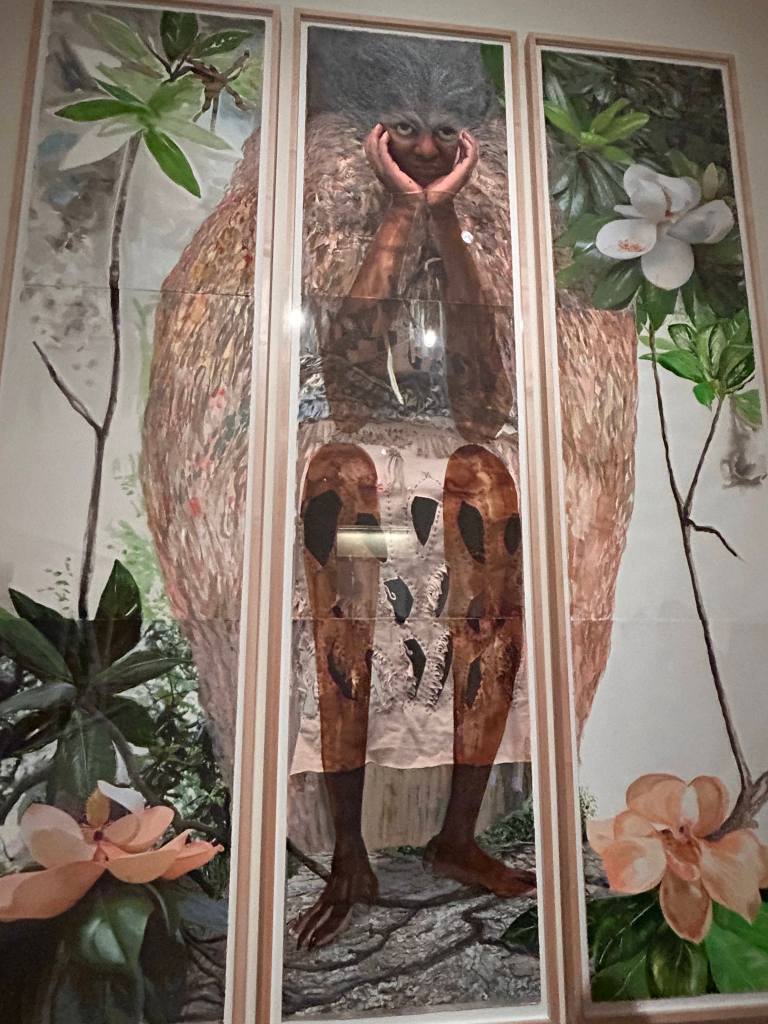
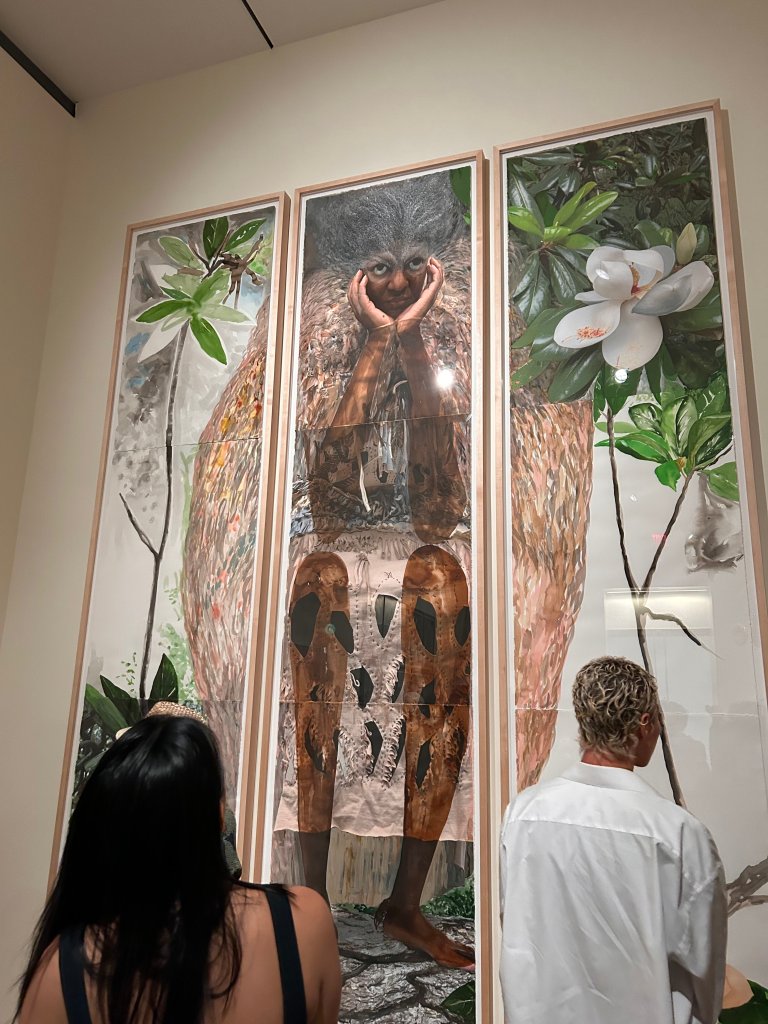
Standing face-to-face with an owl-woman, with her 11 ft tall magnificent figure, with the cascades of multicolor feathers, with the patterns on her body repeating the beauty of the surrounding flora, and finally with her wisdom, you start to feel small. She is crouching down, resting elbows on her knees, nesting her face neatly in the palms of her hands, the tips of her fingers graze her cheeks. She is not looking at you, although do not feel ignored. You are lucky to stand in her presence, cherish that moment, and watch her observe the world. With furrowed brows, focus sharp, she is watching the history unfolding, the time flowing, and the future flourishing.
September 16th was a celebration of María Magdalena Campos-Pons, an Afro-Cuban multimedia artist, mother, daughter, and a true humanist. Organized by the Brooklyn Museum “Behold” and curated by Carmen Hermo, an exhibition and the symposium of the same title, brought together artists, performers, scholars, and long-time friends of María Magdalena, both present in the building that day and in memories and hearts.
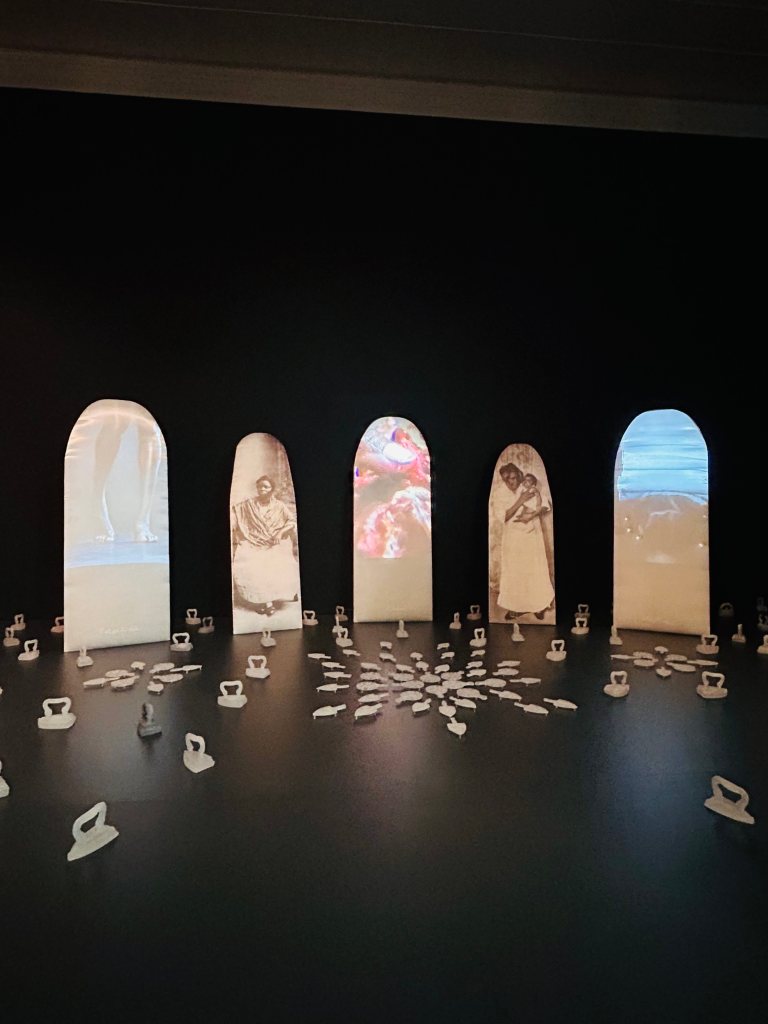
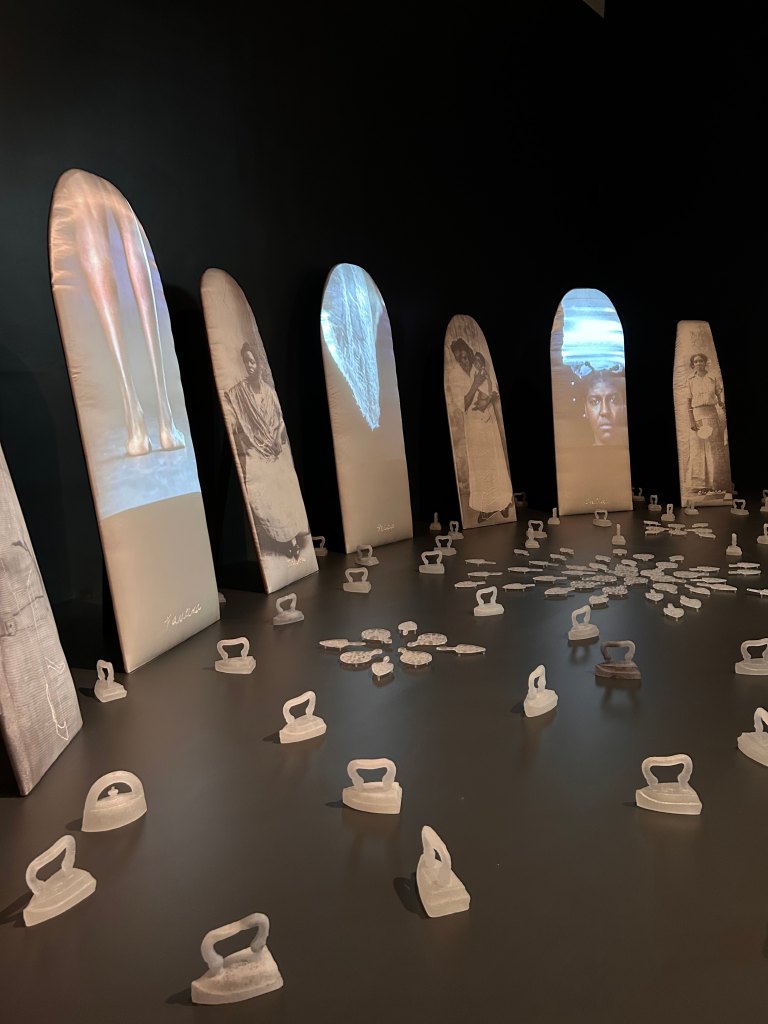
Behold. Be-hold. Be-long. Be-gin. Be-ing. Every “be” is another extension of the self. María Magdalena’s self seems to be endless, multiplying and spreading throughout the generations. Starting with Spoken Softly With Mama (1998), the exhibition introduces the multi- media talent of Campos-Pons’s storytelling. This homage to Afro-Cuban women working as domestic laborers is full of beauty and sadness, cherishing a practice of survival while mourning the time and potential lost laboring for others. The memory of the artist’s ancestors is located in objects, like cast glass irons, embroidered cotton sheets, and ironing boards with images of Black women projected on them. The installation expresses continuous attention to the ideas of looking into history and the future, honoring family and ancestors, and teaching new generations. The act of conversation shared between mother and daughter is depicted as sacred, special, and magical. This particular bond is present in many works of Magda and in the name that she carries. The artist derives Pons from her mother’s, empowering matriarchal rupture to colonist-imposed patriarchal naming traditions.
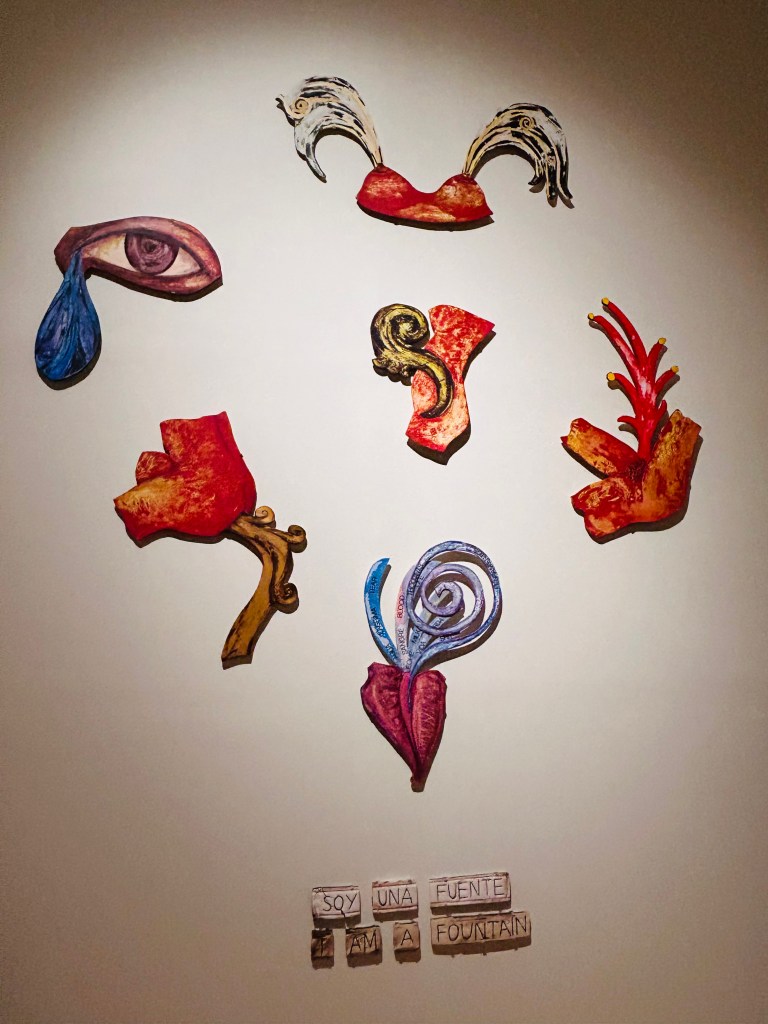
Another prominent leitmotif in her oeuvre is water, a metaphor of life, memory, time, distance, migration, reunion, homecoming, healing, tears, of joy, of grief. I Am a Fountain (1990) explores the notion of bodily fluids, the life-giving system of women’s bodies as sites of production and excess – blood, tears, breast milk, and excrement, all working together in a circle- like motion. Along the cyclical flow of nature, Campos-Pons is reclaiming woman’s body as[…]intellectual entity and generator of knowledge. This reminds me of a beautiful quote, from Saundra Dickerson, also known as Aisha El-Mekki:
My mother would often quote a Ghanaian proverb: “If you educate a man, you educate an individual, but if you educate a woman you educate a family, a nation.”
This humanist need to educate the people lies at the core of I Am a Fountain. The votive-like form of Magda’s work was developed from Codex Mendoza, created by Indigenous artist Francisco Gualpuyogualcal in 1541. The book was commissioned by Spanish colonists to picture and describe the Aztec Empire’s history, both the Aztec rulers and their conquests as well as a description of the daily life of pre-conquest Aztec society. Why that information matters when comparing the two works, divided by 450 years of history? Magda teaches us about dealing with the consequences of the abusive actions of colonization to this day. She is a fountain. She gives life, literally and figuratively. She is a source, of wisdom, love, energy, and creativity.
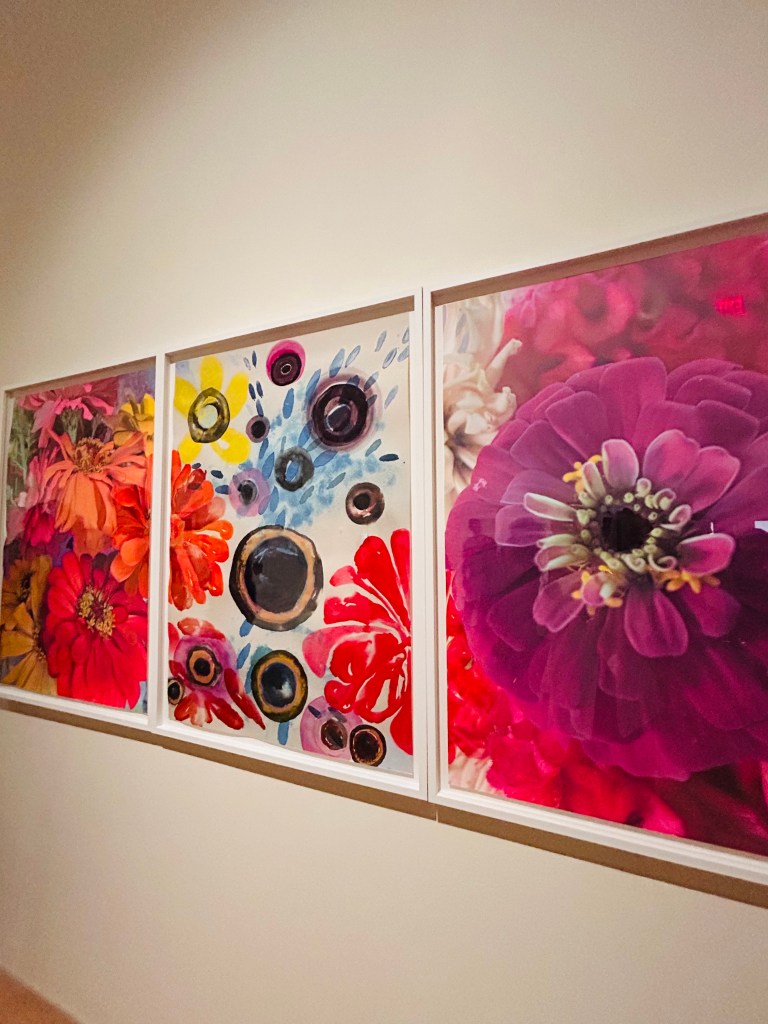
Owl woman, observing, moving, migrating, creating a new language. What moved me during the curatorial tour, was the story about Atlantic. Magda in her newest set of watercolor paintings is depicting and referring to the people lost in the Atlantic waters as departed angels. Not slaves, but angels. This attention to detail, to the formative role and power of language, both spoken and visual is reflected in the work honoring Breonna Taylor as well. Inspired by her beautiful brown eyes, Magda created Butterfly Eyes (for Breonna Taylor), from the series In the year of the pandemic, in the month of the awakening (2021). Cherishing and remembering the beauty of Black women, especially amid present-day micro- and macroaggressions, is not only an act of care but an act of refusal to white supremacists’ language of violence.
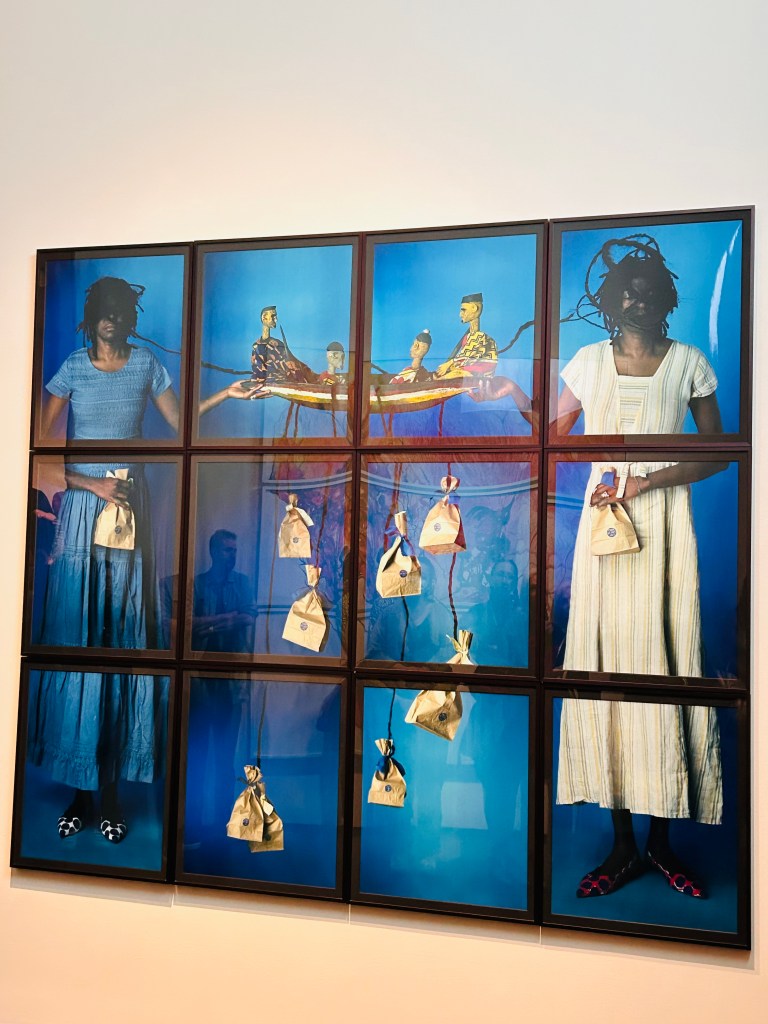
As Carrie Mae Weems said during the symposium, experiencing María Magdalena Campos-Pons’s art is like experiencing ritual outside of sacred space. Moreover, her art has the power to transform museums, institutions, and borders, to connect with the sacred, even when it was stolen, appropriated, or swept under a thick rug of “otherness”. In her series of large-scale Polaroids, fragments of her rich in cross-cultural connections identity, are threaded by the umbilical cord of memory. Evoking the practices of Santería, an African diasporic religion derived from West-African Yoruba beliefs, and survivors of the religious and cultural oppression of colonialism, she embodies Yamaya and Oshun. In a double self-portrait Of the Two Waters (2007), she evokes her two guardian orisha deities, two divine sisters-protectors of people migrating by force, choice, or lack of choice. Connected by braids, a boat, paper bags, and the crux of the personal and global stories, the two figures are centering the voyage as praxis common to humans and deities.
Standing face-to-face with an owl-woman, with her 11 ft tall magnificent figure, with the cascades of multicolor feathers, with the patterns on her body repeating the beauty of the surrounding flora, and finally with her wisdom, you start to feel full. Full of love, knowledge, empathy, better understanding. You notice that there is no cage. She is free. She is observing, crouching, resting. Raising the question that will help you navigate. Healing this planet of greed and violence. Nesting the ideas that will help you to better understand this world.
Text and images by Julia Stachura
 Julia stachura
Leave a comment